
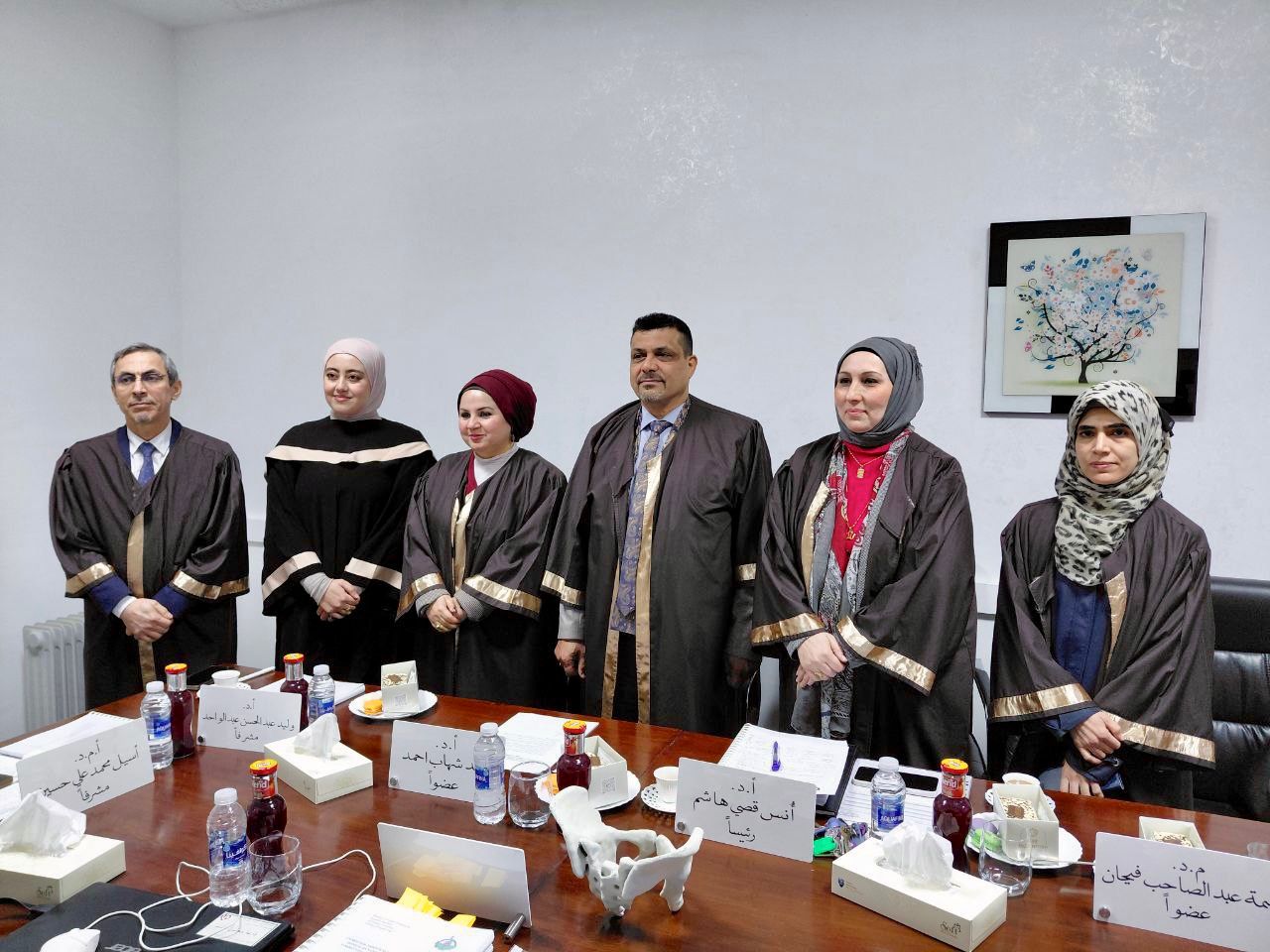
The Master’s thesis defense of the student Batool Abdul Abbas Akkar was held in the Department of Biomedical Engineering on Thursday, 29/01/2026, for her thesis entitled:
“Patient-Specific Digital Planning for Acetabular Defects Reconstruction.”
The examination committee consisted of:
-
Chair: Prof. Dr. Anss Qusay Hashim – College of Engineering / Al-Nahrain University
-
Member: Prof. Dr. Mohammad Shehab Ahmed – Al-Kindy College of Medicine / University of Baghdad
-
Member: Assist. Prof. Dr. Basma Abdul Sahib Fayhan – College of Engineering / Al-Nahrain University
The thesis was supervised by:
-
Assist. Prof. Dr. Aseel Mohammed Ali Hussein – College of Engineering / Al-Nahrain University
-
Prof. Dr. Walid Abdul Hassan Abdulwahid – Arab Board of Health Specializations
The thesis was scientifically evaluated by:
-
First Scientific Evaluator: Prof. Dr. Wajdi Sadiq Aboud – College of Engineering / Al-Nahrain University
-
Second Scientific Evaluator: Assist. Prof. Dr. Ammar Alaa Al-Din Nouri – College of Engineering / Al-Iraqia University
It was linguistically reviewed by:
-
Dr. Alaa Ayed Jabr – College of Engineering / Al-Nahrain University
This study aims to develop a digital methodology based on virtual surgical planning and three-dimensional modeling to evaluate and reconstruct acetabular defects in a patient-specific manner. The approach contributes to improving preoperative planning accuracy and enhancing joint stability in hip replacement surgeries, particularly in complex cases and revision procedures.
The study relied on computed tomography (CT) images, which were processed using open-source software such as 3D Slicer, Meshmixer, and Blender to perform bone segmentation, three-dimensional reconstruction, design patient-specific implants, and accurately determine the hip joint center of rotation (COR). In addition, 3D-printed models were produced to verify design accuracy and anatomical compatibility.
The results demonstrated that the proposed methodology successfully identified the precise shape and size of acetabular defects and produced realistic, anatomically accurate 3D models. This enabled restoration of the center of rotation to a position very close to the natural anatomical state. The designed implants also showed high conformity with the bone defects, enhancing implant stability and reducing surgical time and potential complications.
The study confirms that adopting patient-specific digital planning using open-source tools represents a practical and cost-effective solution that can improve outcomes of complex hip surgeries and contribute to enhancing healthcare quality, especially in resource-limited settings.
Accordingly, the thesis was accepted as it fulfills the requirements for the Master’s degree in Biomedical Engineering.


