
Visitors: 37244556 Views
Done By: Department of Biomedical Engineering
Post Date: 2026-03-02
Last Browse: 2026-03-07
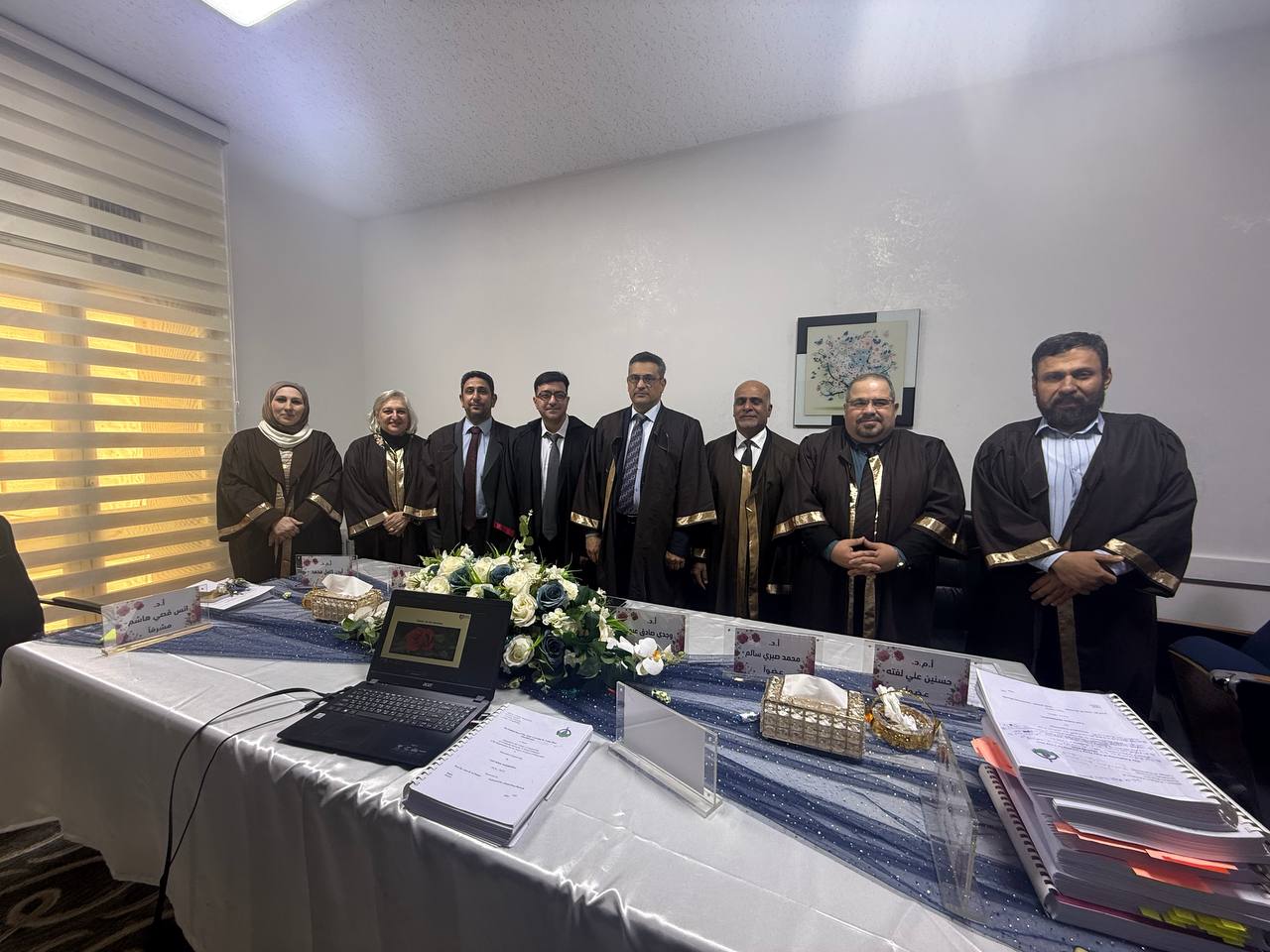
The PhD student Yasser Salam Abdul Ghafour defended his dissertation in the Department of Biomedical Engineering, College of Engineering – Al-Nahrain University on Monday, March 2, 2026. His dissertation was entitled: “The Employing of Tiny Deep Learning for Lung Mass Identification.” The examination committee consisted of: Prof. Dr. Wajdi Sadiq Abboud – Chair Prof. Dr. Ali Hussein Mari – Member Prof. Dr. Mohammed Sabri Salem – Member Asst. Prof. Dr. Hasnain Ali Lafta – Member Asst. Prof. Dr. Aiden Kamil Mohammed – Member Prof. Dr. Anas Qusai Hashim – Member and Supervisor Asst. Prof. Dr. Ahmed Faik Hussein – Member and Supervisor The dissertation aims to employ and apply the concept of Tiny Deep Learning for the detection of lung masses using lightweight convolutional neural networks (CNNs) implemented on a resource-constrained embedded computer in terms of energy, processing power, and storage. The study also focuses on designing a portable device that can assist physicians in diagnosing lung masses, particularly for doctors working in remote areas who may not have access to advanced computers capable of running artificial intelligence diagnostic applications. Four lightweight neural network models were used: MobileNetV2, EfficientNetB0, SqueezeNet, and ShuffleNet. These models were implemented on the embedded computer Raspberry Pi 5. Each model was tested twice: once using a pre-trained approach and once trained from scratch. The models were trained using chest X-ray datasets obtained from the National Institutes of Health in Maryland, United States. The results were compared in terms of diagnostic performance, energy consumption, and electrical power usage. The findings showed that the MobileNetV2 model achieved the highest efficiency, particularly in terms of diagnostic accuracy for lung masses and lower energy consumption during the multiple computational operations within the network. The EfficientNetB0 model ranked second in terms of performance and energy efficiency.
The dissertation was accepted as it fulfilled the requirements for obtaining a PhD degree in Biomedical Engineering.
(College of Engineering – Al-Nahrain University)
(Al-Khwarizmi College of Engineering – University of Baghdad)
(College of Engineering – Al-Nahrain University)
(College of Engineering – Al-Nahrain University)
(Al-Khwarizmi College of Engineering – University of Baghdad)
(College of Engineering – Al-Nahrain University)
(College of Engineering – Al-Nahrain University)